Folate, Methylfolate, MTHFR, and Mood

Folate, Methylfolate, MTHFR, and Mood
What is Folate?
Folate, also called vitamin B-9 or folic acid, is a B vitamin found mainly in dark green leafy vegetables, beans, peas, nuts, oranges, lemons, bananas, melons and strawberries. Folate has important roles in red blood cell formation, cell growth, and cell functioning. It is also a very important vitamin during neurodevelopment. Let’s first discuss how folate is transformed in the body.
Folate is converted into L-methylfolate (L-MF)
- Folate, also called folic acid, is converted to dihydrofolate (DHF) and then tetrahydrofolate (THF) by the enzyme dihydrofolate reductase (DHFR).
- Serine hydroxymethyl-transferase (SHMT) then converts tetrahydrofolate (THF) to methylene-tetrahydrofolate (THF).
- Methylene tetrahydrofolate (THF) is converted by methylene tetrahydrofolate reductase (MTHFR) to L-methylfolate.

Methylenetetrahydrofolate reductase (MTHFR) is an important enzyme in the production of L-methylfolate
As we discussed above, L-methylfolate, the active form of folate, is very important in the production of brain chemicals that regulate mood such as dopamine, norepinephrine, and serotonin. The methylenetetrahydrofolate reductase (MTHFR) enzyme (the chef in the figure below) is an important enzyme involved in the conversion of folic acid (folate) into L-methylfolate.

What does any of this have to do with mood?
Some individuals carry a mutation (or change in the gene) which results in reduced activity of MTHFR.
Below are a few genetic variants of MTHFR:
Methylene tetrahydrofolate reductase: MTHFR C677T; MTHFR A1298C
If an individual’s MTHFR activity is reduced, then they are “struggle” to convert folate to L-methylfolate.
Without enough L-methylfolate, the body may not be able to produce enough serotonin, dopamine, or norepinephrine and this may explain why certain medications that rely on adequate levels of these brain/mood chemicals (such as selective serotonin reuptake inhibitors and serotonin norepinephrine reuptake inhibitors) don’t work that well in some people. That is, if there is little to no serotonin or norepinephrine available to be released, then reuptake inhibition of serotonin or norepinephrine won’t do much.
In those individuals with reduced capacity to convert folate to L-methylfolate, supplementation with L-methylfolate may increase production of those important brain/mood chemicals and hypothetically improve the responsiveness to antidepressants and other medications that rely upon the presence of those brain/mood chemicals to work properly.
For more information on MTHFR, Click Here.

DNA Methylation, L-Methylfolate, and COMT
DNA methylation occurs when a methyl (-CH3) group is attached to DNA. When this happens, the DNA molecule becomes more tightly coiled and this, in turn, prevents gene expression.
In other words, methylation silences genes.
L-Methylfolate is considered a “methylator” as it provides a methyl group for this type of DNA methylation.
Why does this matter?
Catechol-O-methyl-transferase (COMT) is an important enzyme that breaks down monoamines like dopamine and norepinephrine.
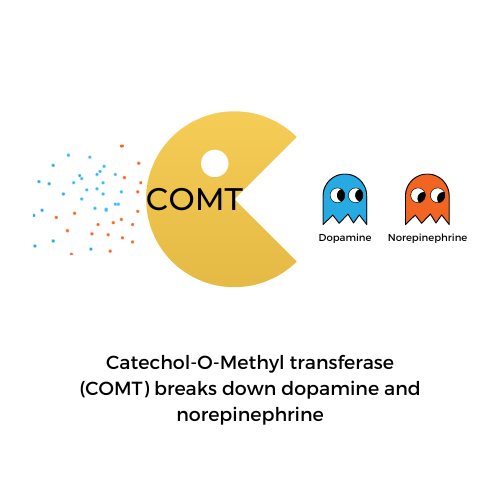
The more COMT there is, the more dopamine is broken down and therefore less available for neurotransmission.
If L-methylfolate is low, then perhaps this means less methylation of various genes such as COMT.
Since methylation reduces genetic expression, decreased methylation of, say, COMT, would mean INCREASED genetic expression of COMT. The more COMT, the more breakdown of monoamines.
Studies have shown genetic variability in the expression of COMT in patients with disorders such as Schizophrenia. Some variants of the COMT gene result in greater expression of COMT and less dopamine availability in areas of the brain like the prefrontal cortex (PFC).
Decreased dopamine levels in a specific area of the prefrontal cortex called the dorsolateral prefrontal cortex (DLPFC) could impair information processing and cause symptoms such as cognitive dysfunction.
Therefore, L-methylfolate supplementation would, theoretically, result in higher dopamine levels in those brain areas and improve cognitive deficits in individuals with that gene variant of COMT.
Folate and Drug Interactions
Folate + Anticonvulsants
Taking folic acid with fosphenytoin (Cerebyx), phenytoin (Dilantin, Phenytek) or primidone (Mysoline) might decrease the drug’s concentration in your blood.
Folate + Barbiturates
Taking folic acid with a drug that acts as a central nervous system depressant (barbiturate) might decrease the drug’s effectiveness.
Folate + Methotrexate (Trexall)
Taking folic acid with this medication used to treat cancer could interfere with its effectiveness.
Folate + Pyrimethamine (Daraprim)
Taking folic acid with this antimalarial drug might reduce the effectiveness of the drug.
Folate Facts
- The recommended daily amount of folate for adults is about 400 micrograms (mcg). For adult women who are planning pregnancy or could become pregnant the recommended daily amount of folate is usually 400 to 1,000 mcg per day.
- Folate works together with other vitamins such as B-6 and B-12 to regulate high levels of something called homocysteine. Elevated homocysteine levels in the blood have been shown to increase the risk of cardiovascular diseases.
- Increased intake of folate can mask the megaloblastic anemia associated with vitamin B-12 deficiency, which may go undiagnosed and cause irreversible nerve damage.
References
- Cooper, J. R., Bloom, F. E., & Roth, R. H. (2003). The biochemical basis of neuropharmacology (8th ed.). New York, NY, US: Oxford University Press.
- Iversen, L. L., Iversen, S. D., Bloom, F. E., & Roth, R. H. (2009). Introduction to neuropsychopharmacology. Oxford: Oxford University Press.
- Puzantian, T., & Carlat, D. J. (2016). Medication fact book: for psychiatric practice. Newburyport, MA: Carlat Publishing, LLC.
- J. Ferrando, J. L. Levenson, & J. A. Owen (Eds.), Clinical manual of psychopharmacology in the medically ill(pp. 3-38). Arlington, VA, US: American Psychiatric Publishing, Inc.
- Schatzberg, A. F., & DeBattista, C. (2015). Manual of clinical psychopharmacology. Washington, DC: American Psychiatric Publishing.
- Schatzberg, A. F., & Nemeroff, C. B. (2017). The American Psychiatric Association Publishing textbook of psychopharmacology. Arlington, VA: American Psychiatric Association Publishing.
- Stahl, S. M. (2014). Stahl’s essential psychopharmacology: Prescriber’s guide (5th ed.). New York, NY, US: Cambridge University Press.
- Stahl, S. M. (2013). Stahl’s essential psychopharmacology: Neuroscientific basis and practical applications (4th ed.). New York, NY, US: Cambridge University Press.
- Whalen, K., Finkel, R., & Panavelil, T. A. (2015). Lippincotts illustrated reviews: pharmacology. Philadelphia, PA: Wolters Kluwer.
- Charney and Nestler’s Neurobiology of Mental Illness. 5th Ed. Oxford University Press. 2017.

Pingback: A list of psychotropic medications - MTI PSYCHIATRY
Pingback: Medication Algorithms for Mental Disorders - MTI PSYCHIATRY